Bhutan in Monsoon: The Counterintuitive Case for Visiting in June, July & August
By Karma Wangchuk · June 27, 2026 · 22 min read
Every travel guide to Bhutan says roughly the same thing about June through August: avoid it. The monsoon, they warn, brings flooding roads, leeches, landslides, and perpetual grey skies. The conventional wisdom has calcified into orthodoxy: visit in October, or in spring. Never in July.
And so July in Bhutan has become the best-kept secret in Himalayan travel.
The queues at Tiger's Nest — sometimes two hours long in October — shrink to nothing. The packages drop by 20 to 30 percent. The valleys, stripped of their dry-season dust and winter brown, ignite into a green so saturated it looks digitally enhanced. The rivers that are gentle trickles in March become thundering silver highways of glacial meltwater. Every waterfall that doesn't exist on any tourist map suddenly exists, and it is magnificent.
This is not a guide telling you that monsoon Bhutan is perfect. It has real challenges and you must understand them honestly. But it is a guide telling you that the conventional wisdom is wrong — or at least, profoundly incomplete. Monsoon Bhutan is not a compromise. For certain kinds of travelers, it is the finest Bhutan there is.
Understanding Bhutan's Monsoon: Why It's Different Here
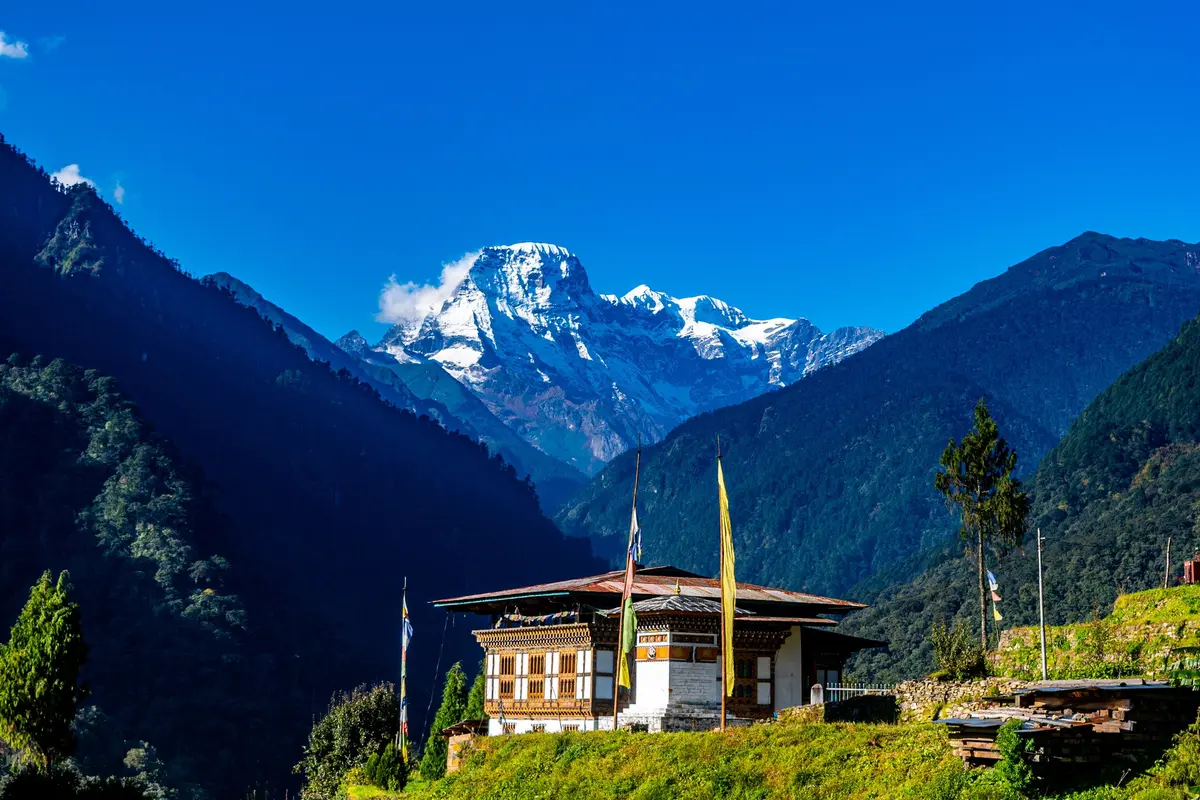
Bhutan sits at a meteorological crossroads. The Bay of Bengal monsoon, which dominates South and Southeast Asia from June to September, sweeps northward into the subcontinent and eventually collides with the eastern Himalayas. Bhutan, occupying the eastern anchor of the Himalayan arc, receives some of the heaviest rainfall in all of South Asia — but not uniformly.
The Geography of Rain
Bhutan's extraordinary topographic diversity — dropping from 7,500-metre peaks to subtropical foothills within a horizontal distance of 150 kilometres — means that monsoon behaves very differently depending on where you are:
| Region | Elevation | Monsoon Character |
|---|---|---|
| Southern foothills (Phuentsholing, Gelephu) | 150–600m | Very heavy rain, humid, occasional flooding |
| Central valleys (Paro, Thimphu, Punakha) | 1,200–2,700m | Moderate rain, morning mist, afternoon showers |
| High plateau (Bumthang, Trongsa) | 2,600–3,500m | Lighter rain, cool, dramatic cloud formations |
| High Himalaya (above 3,500m) | 3,500–7,500m | Rain transitions to snow; passes may close |
The critical insight: the tourist circuit — Paro, Thimphu, Punakha, Wangdue — sits in the central valley zone. This elevation band receives the monsoon but is partially sheltered by the Himalayan barrier to the north and the ridgelines surrounding each valley. Rain falls heavily but predictably, typically in the afternoon and evening, leaving mornings relatively clear.
This is categorically different from, say, Kerala or Bangkok in monsoon, where rain can be relentless and all-day. In Bhutan's central valleys, a typical monsoon day runs: clear or partly cloudy morning → building clouds by noon → rain from 2–6 PM → clear or clearing evening. That morning window is everything.
The Rain Shadow Effect in Punakha
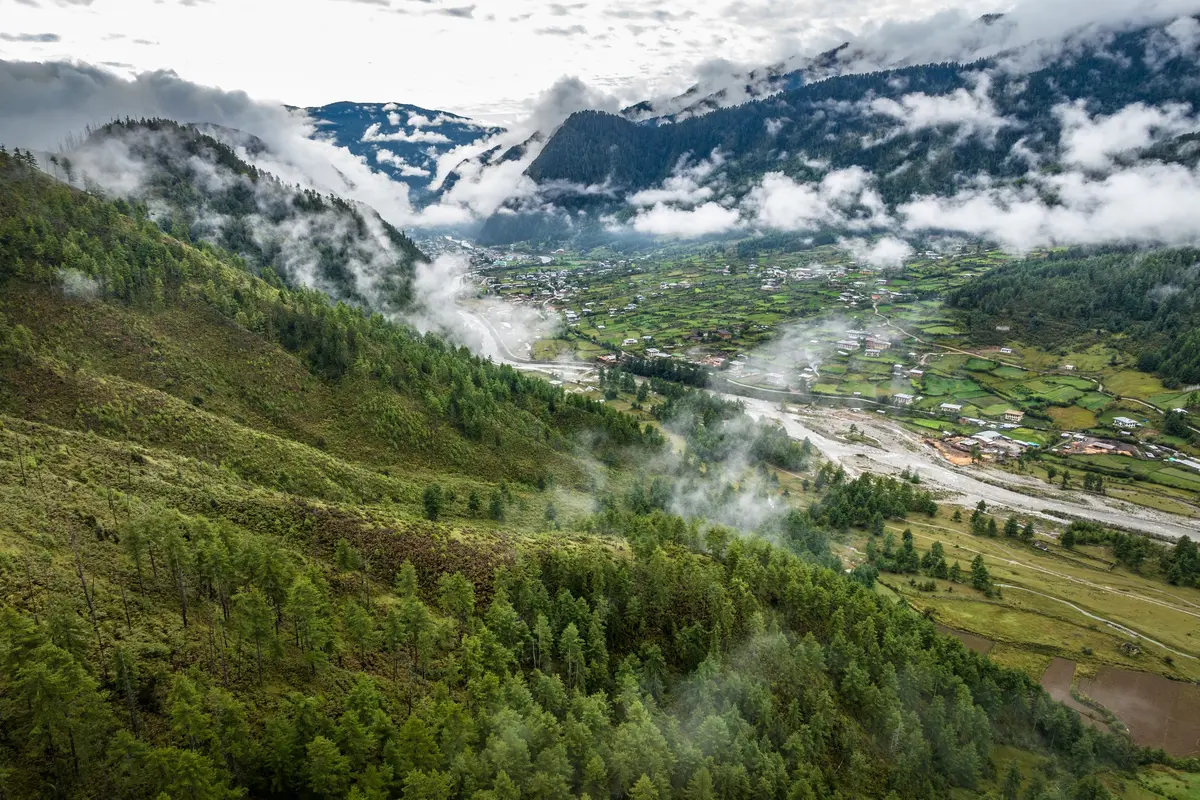
Punakha — Bhutan's former capital and home to the magnificent confluence of the Pho Chhu and Mo Chhu rivers — occupies a rain shadow valley at 1,240 metres. Even in peak monsoon months, Punakha receives considerably less rainfall than Thimphu (which is 400 metres higher) and often experiences sunny mornings even during July. This makes it one of the best monsoon destinations in the entire country.
Month-by-Month Monsoon Breakdown
June: The Shoulder Month (Best Gateway to Monsoon)
June is genuinely transitional. The monsoon typically arrives in Bhutan's south in late May and creeps northward through June, reaching Thimphu and Paro around mid-month. The first half of June can be remarkably pleasant — warm, green, with occasional dramatic afternoon storms but without the full monsoon intensity. The second half brings more consistent rain.
Why June is special:
- Pre-monsoon wildflowers are extraordinary: rhododendrons may still be blooming at elevation
- Tourist numbers drop sharply after the spring peak, but conditions remain largely excellent
- Package costs begin falling by 15–20% from spring peaks
- Rivers begin filling but waterfalls haven't yet reached their maximum drama
June reality check: Some higher treks (Jomolhari above 4,000m) should be avoided due to unstable snow conditions and trail damage from snowmelt. Druk Path is manageable with caution.
July: Peak Monsoon (The Secret Month)
July is the heart of monsoon and, counterintuitively, one of the most visually spectacular months to visit Bhutan. Rain is consistent but follows the predictable afternoon pattern in most central valleys.
Why July is spectacular:
- Valley vegetation reaches maximum greenness — the Paro and Punakha valleys look impossibly lush
- Major waterfalls are at full volume; dozens of seasonal falls appear on previously dry cliff faces
- Haa valley, partially shielded by mountains, can have remarkable clear days
- The famous Haa Summer Festival typically falls in late July — a vibrant two-day celebration of Haa district culture with archery, yak racing, and traditional food
July reality check: Road conditions on some secondary routes can deteriorate. The Thimphu-Punakha highway (the most-used tourist route) is generally well-maintained. Landslides are a real risk on mountain roads; always check conditions with your guide.
August: Late Monsoon (Transition and Festivals)
August brings the first signs of monsoon weakening. By mid-August, the frequency of rain typically decreases slightly, mornings grow clearer, and the light takes on a quality that photographers specifically seek — golden and hazy with dramatic cloud formations.
August also carries some of Bhutan's most important festivals:
- Thimphu Tshechu (dates vary by lunar calendar, often September but can fall in late August) — the largest annual religious festival in the capital, with masked dances, enormous thangka unfurling, and thousands of Bhutanese in traditional dress
- Nimalung Tshechu in Bumthang — one of the most intimate and authentic festivals in the country
- Ura Yakchoe preparations in Bumthang
August reality check: Bhutanese farmers are in full agricultural activity during August — rice planting, wheat harvesting — which actually makes this one of the best months to see authentic rural life. The terraced fields of Punakha are particularly beautiful with young green rice.
Seven Reasons Monsoon Bhutan is Underrated
1. The Green is Unlike Anything Else
There is a quality of Bhutanese green in July that simply does not exist in any other season. The combination of extraordinary soil richness, clean glacial water, and monsoon rain creates a vegetative explosion that covers every surface — valley floors, dzong walls, cliff faces, and rooftops alike are draped in vegetation. Photographs taken in July have a supersaturated quality that photographers often mistake for over-editing; it is simply what July looks like.
The Punakha valley — already stunning in spring with its mustard fields — transforms into a deep, layered green that frames the white and gold of Punakha Dzong against a backdrop that looks like a Himalayan Eden.
2. The Waterfalls
Bhutan is a land of waterfalls. In the dry seasons, many of these falls are thin threads — elegant but modest. In monsoon, they become something else entirely. The road from Thimphu to Punakha passes through the Dochu La pass (3,140m), and in July, every cliff face along the descent toward Punakha carries a waterfall. The Chuzomsa area on the Punakha highway is a continuous gallery of cascades.
"I drove the Thimphu-Punakha road in April and again in July. In July, I counted at least thirty waterfalls that simply did not exist in spring. It felt like driving through a different country."
— Marco B., Italian traveler, July 2025
3. No Queues. None.
The Tiger's Nest trail in October can mean two-hour queues at the gate. Paro's Rinpung Dzong is packed with tour groups in spring. In July, you may have the first viewpoint to Tiger's Nest entirely to yourself. The silence and solitude fundamentally change the experience — you are not navigating around other people's cameras; you are simply there, in the mountain.
For travelers who prioritize authentic presence over Instagram-perfect conditions, monsoon is incomparable.
4. Lower Costs — Significantly
Bhutan's SDF of $100 per person per night is fixed by law and applies year-round. But tour package costs — the accommodation, guides, transport, and ground arrangements that make up the rest of your daily rate — are substantially negotiable in monsoon, and operators compete more aggressively for a smaller pool of travelers.
| Season | Typical 7-Night Package (per person, all-inclusive) |
|---|---|
| Peak (Oct–Nov, Mar–Apr) | $1,800–$2,500 |
| Shoulder (Dec, May) | $1,500–$1,900 |
| Monsoon (Jun–Aug) | $1,200–$1,600 |
The SDF ($100/night = $700 for 7 nights) is fixed within all of the above figures. What changes is the tour operator's ground rate. In monsoon, savings of $300–$600 per person on a week-long trip are realistic. For a couple, that is $600–$1,200 back in your pocket.
Additionally, some boutique hotels — particularly in Paro and Thimphu — offer room discounts during monsoon. The ultra-luxury properties (Amankora, Six Senses) maintain their rates year-round, but mid-range 4-star operators frequently discount by 20–25%.
For a full breakdown of Bhutan vacation costs, read our Bhutan Vacation Cost Guide.
5. The Agricultural Landscape Is Alive
Bhutan's farming culture is inseparable from monsoon. July and August are when rice paddies are being planted across the Punakha valley and lower Paro valley — a labour-intensive, communal process that involves entire villages working together, singing traditional songs, their gho and kira hitched up against the mud and water. Witnessing this is a privilege that no spring or autumn visitor ever gets.
The terraced fields of Lobesa in Punakha, filled with knee-deep water reflecting the sky and bordered by the white walls of Punakha Dzong, are one of the most genuinely beautiful agricultural landscapes in Asia.
6. Bhutanese Biodiversity Peaks in Monsoon
Bhutan is one of the world's biodiversity hotspots, and monsoon is when that biodiversity is most visible. Bird species that winter at lower altitudes ascend to higher elevations, creating exceptional birdwatching conditions. Butterflies emerge in extraordinary numbers. The forests around Paro and Bumthang fill with wildflowers — blue poppies (the national flower), orchids, and primulas — that no dry-season visitor sees.
For nature photographers and birdwatchers specifically, July–August in Bhutan is a serious consideration, not a compromise.
7. The Light
Professional photographers know that overcast light — the diffused, shadow-free illumination that comes from an even cloud cover — is often superior to harsh direct sun. Monsoon Bhutan offers this in abundance. Dzong walls glow against brooding skies. Monks in crimson robes pop with colour that gets washed out in bright summer sun. The mist that clings to valleys in the early morning creates depth and atmosphere that no amount of post-processing can replicate.
Bhutan's most photographed image — Tiger's Nest Monastery — appears entirely differently in monsoon: the cliff faces are dark with moisture, seasonal waterfalls cascade on either side, and the monastery itself sits in a wreath of cloud that gives it the mythological quality that its legend demands.
Honest Challenges: What Monsoon Bhutan Actually Involves
Road Conditions and Landslides
This is the most serious real consideration. Bhutan's mountain roads are carved into steep terrain and are genuinely vulnerable to landslide during heavy rain. Major routes — Thimphu to Paro, Thimphu to Punakha, Punakha to Trongsa — are well-maintained and cleared quickly when slides occur. Secondary roads to remote areas are less reliable.
What this means practically:
- Always travel with a licensed guide who has current road condition information
- Build flexibility into your schedule — if a road is closed for 4–6 hours due to a slide clearance, you need a contingency
- Avoid travel on secondary mountain roads during or immediately after heavy overnight rain
- The eastern Bhutan highway (toward Tashigang) can have extended closures in peak monsoon; plan eastern itineraries for late August or early September if road access is a priority
Leeches on Forest Trails
In lower and mid-elevation forest trails during monsoon, leeches are an unavoidable reality. They are harmless — they don't transmit disease in Bhutan — but deeply unpleasant for those unaccustomed to them.
Practical leech management:
- Wear long socks and tuck trousers into them
- Apply salt solution or commercial leech repellent (DEET works) to boot laces and sock tops
- Inspect legs every 20–30 minutes on forest trails
- If a leech attaches, use a credit card or fingernail to detach it from the skin edge (do not pull from the middle)
- They are largely absent above 2,500m, so high-altitude treks avoid them entirely
Tiger's Nest trail (mostly above 2,000m, on rocky terrain) typically has minimal leech activity.
Trekking Limitations
The major multi-day treks — Jomolhari, Snowman, Dagala, Bumthang Cultural Trek — are generally inadvisable in peak monsoon for several reasons: trail erosion, river crossing danger, muddy camping sites, and visibility that reduces high-altitude mountain panoramas to near-zero. Most licensed guides will strongly advise against these treks in July–August.
What IS trekable in monsoon:
- Tiger's Nest day hike ✅ (rocky trail above leech zone, excellent in monsoon mist)
- Cheri Monastery hike ✅ (short, well-maintained)
- Bumdra trek with caution ✅ (popular, manageable in non-peak rain)
- Paro valley day hikes ✅
- Bumthang Cultural Trek (lower sections) ✅ with local guide
- Dochula-Lungchutse day hike ✅
Visibility on Mountain Passes
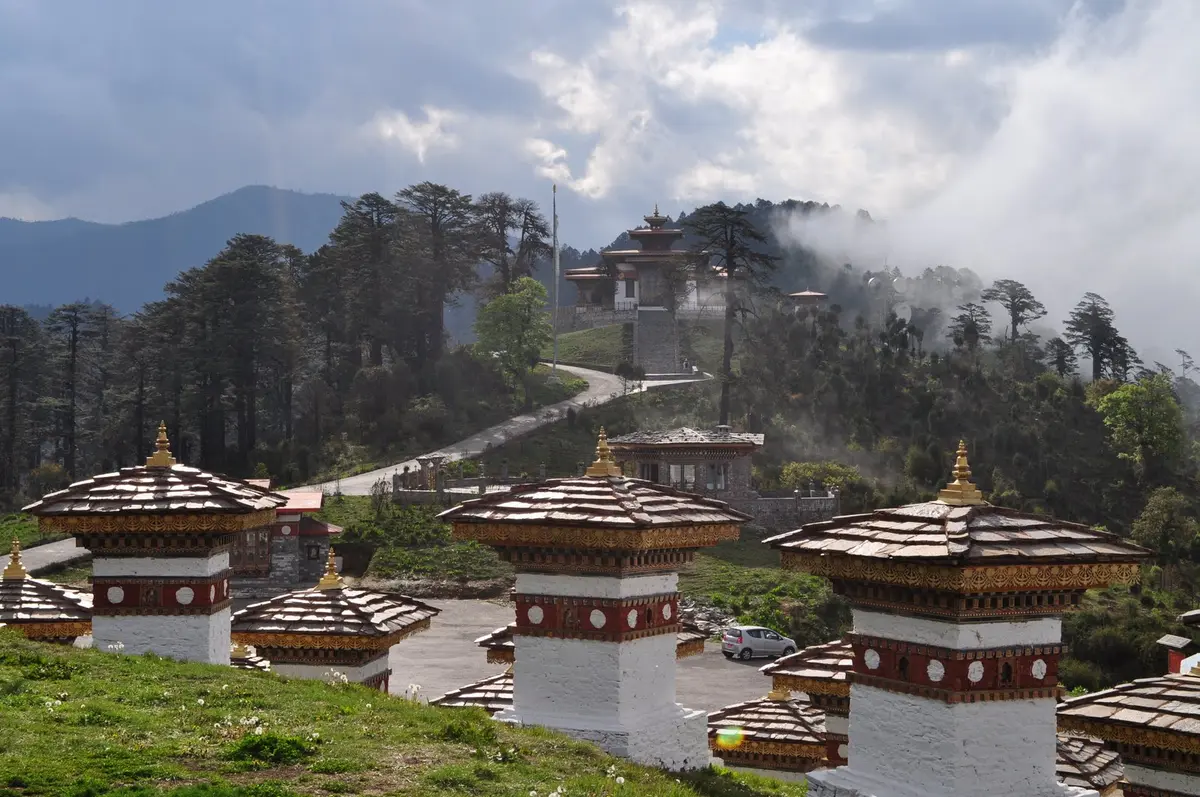
The high passes — Dochula La (3,140m), Pele La (3,300m), Chele La (3,988m) — are frequently socked in cloud during monsoon. If seeing the Himalayan panorama of Bhutan's northern peaks is the primary reason for your visit, monsoon will often disappoint on this specific point. Clear summit views of Gangkhar Puensum and Jomolhari are rare in July–August.
However — and this matters — cloud-shrouded passes have their own dramatic beauty. The Dochula's 108 chortens emerging from thick mist is genuinely one of the more atmospherically powerful images Bhutan has to offer.
The Best Monsoon Destinations in Bhutan
Punakha Valley: The Undisputed Monsoon Capital
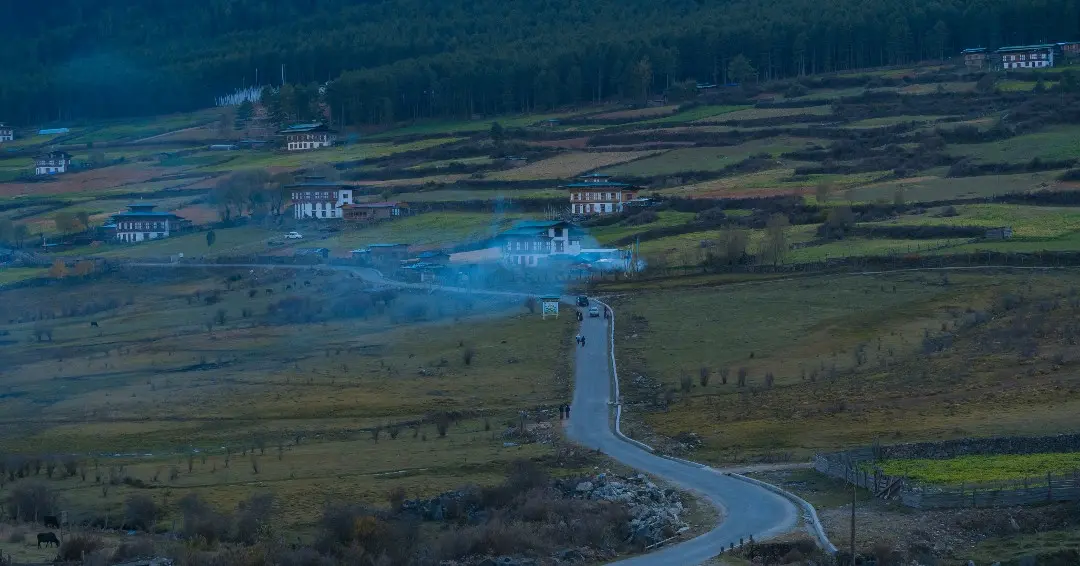
If you visit Bhutan in monsoon and do only one thing right, go to Punakha. The valley's rain shadow location, low elevation, and extraordinary landscape — the Pho Chhu and Mo Chhu rivers at full flood framing Punakha Dzong — make it the definitive monsoon destination. Morning light here, even in July, is frequently clear and golden.
Don't miss:
- Punakha Dzong at the river confluence — the rivers are at maximum volume and the dzong appears almost to float
- Khamsum Yuling Namgyal Chorten — hike up the ridge for views of the flooded rice paddies below
- Punakha Suspension Bridge — crossing above full-flow Mo Chhu is a genuine experience
- Lobesa rice fields — planting season creates extraordinary landscapes (late June to mid-July)
Paro Valley: History and Mystery in the Mist
Paro at 2,200m receives more rain than Punakha but offers cultural sites that are extraordinary in monsoon atmosphere. The Rinpung Dzong reflected in the Paro Chhu — swollen and fast in July — has a medieval drama that dry-season visits lack.
Tiger's Nest in monsoon mist is, for many photographers and spiritual travelers, the most powerful version of the experience available. The monastery, built into the cliff above where Guru Rinpoche meditated, emerges from and disappears into cloud throughout the day — exactly as its sacred biography suggests it should.
Thimphu: Urban Bhutan Plus the Dochula
Thimphu functions normally in monsoon and is actually livelier with local festivals and cultural activity. The National Memorial Chorten, the Tashichho Dzong, and the weekend market are all fully operational and less tourist-saturated.
The 30-minute drive to Dochula Pass is a monsoon highlight: the 108 chortens in heavy mist, surrounded by blue poppies blooming along the roadside, is one of the most photographically rewarding drives in the country during any season.
Haa Valley: The Monsoon Hidden Gem
Haa — accessed via the Chele La (3,988m), Bhutan's highest motorable pass — sits partially in a rain shadow created by the Himalayan ridgeline to the north. It receives substantially less rain than Paro and Thimphu in peak monsoon. The valley retains a deeply traditional character — it was only opened to tourists in 2002 — and its lower visitor numbers year-round make it a genuine escape.
The Haa Summer Festival (late July) is one of Bhutan's most authentic celebrations and was specifically created to share Haa's culture with visitors.
Bumthang: Cultural Heartland at High Altitude
At 2,580–3,500m, Bumthang sits above the main monsoon zone and receives lighter, cooler rain than the western valleys. It is Bhutan's spiritual and cultural heartland — home to some of the country's oldest temples including Jambay Lhakhang (7th century) and Kurje Lhakhang. Nimalung Tshechu (August) happens here.
The drive from Thimphu to Bumthang via the Pelela Pass (3,300m) is breathtaking in monsoon — green beyond any spring equivalent, with the pass frequently swathed in dramatic rolling cloud.
Monsoon Festivals: The Cultural Calendar
One of the most overlooked aspects of monsoon travel is the festival calendar. Bhutan's Tshechu festivals follow the lunar calendar, and several fall squarely in the monsoon window:
| Festival | Location | Approximate Dates | Highlights |
|---|---|---|---|
| Haa Summer Festival | Haa Valley | Late July | Yak racing, archery, traditional food, folk performances |
| Nimalung Tshechu | Bumthang | August (lunar) | Mask dances, intimate and authentic, small crowds |
| Paro Tshechu (if timed) | Paro | Late spring to early June | Giant thangka unfurling at dawn |
| Ura Yakchoe | Bumthang | May/June | Among the most sacred, very limited tourists |
| Thimphu Tshechu | Thimphu | Sept (late Aug some years) | Largest festival, enormous thangka, thousands attend |
The Haa Summer Festival deserves particular mention: it is a government-supported celebration designed to introduce visitors to one of Bhutan's least-known valleys, and it deliberately falls during the monsoon low season to attract travelers who would otherwise skip this period. Yak racing, traditional sports, local food, and performances by communities from across the district make it a wholly authentic experience.
Photography in Monsoon: A Specific Guide
For photographers, monsoon Bhutan requires a different approach but offers rewards unavailable in any other season.
What Works Best
Waterfalls and rivers — the single most compelling monsoon photographic subject. The rivers running under the Punakha suspension bridge and the cascades appearing on the Dochula descent are extraordinary. Slow shutter speeds (1/4 to 1 second) with a neutral density filter create silk-water effects that are sublime.
Mist and monastery — the half-hidden monastery or dzong emerging from cloud is a uniquely monsoon image. Tiger's Nest, Rinpung Dzong, and Tashichho Dzong all gain something mystical from the monsoon atmosphere that clear-sky photography lacks.
Agricultural landscapes — rice paddy planting in Punakha and Lobesa, workers in traditional dress, terraced fields flooded with water reflecting the sky above. This is available for a few weeks only (late June to mid-July) and is extraordinarily beautiful.
Blue poppies — Meconopsis betonicifolia, Bhutan's national flower, blooms from late May through July at mid-to-high elevation. The Dochula area and Chele La area carry significant populations. No other season offers this.
What Doesn't Work
Long-distance mountain views are unreliable. If you specifically need the Himalayan panorama photograph — snow peaks against blue sky — plan for spring (March–May) or autumn (September–November). In July, views above 3,500m are frequently obscured.
Practical Photography Gear for Monsoon
- Weather-sealed camera body — essential, not optional
- Lens cloths × 4 minimum — moisture is constant
- Waterproof camera bag — not just water-resistant
- Circular polarizer — cuts through haze and saturates the greens
- ND filter (3-stop) — for waterfall long exposures
- Plastic bags — wrap lenses when not shooting in heavy rain
- Microfibre cloths for lens cleaning
- Silica gel packets — for overnight storage to prevent fungal growth on lenses
Monsoon Packing List: What You Actually Need
Clothing
| Item | Notes |
|---|---|
| Waterproof jacket | Hardshell, not softshell. This is non-negotiable. |
| Quick-dry trousers × 2–3 | Avoid cotton — it stays wet for hours |
| Quick-dry shirts × 4–5 | Merino wool ideal; synthetic is fine |
| Warm fleece or mid-layer | Evenings at altitude drop to 8–12°C even in July |
| Long waterproof hiking socks × 4 | For leech protection and blister prevention |
| Gaiters (lightweight) | For forest trails and rice paddy walking |
| Compact umbrella | For town walking and dzong visits when camera out |
| Traditional dress (gho/kira) | You'll need these for dzong entries; your operator can arrange rental |
Footwear
- Waterproof hiking boots — minimum ankle height, Gore-Tex lined. Your boots will get wet. Make sure they can handle it and still support your feet.
- Flip flops or Crocs — for hotel rooms, river crossings where boots come off, and evening use
- Boot-drying: request a boot-dryer from your hotel or stuff with newspaper each night
Health and Protection
| Item | Notes |
|---|---|
| DEET insect repellent (30%+) | Leeches, mosquitoes at lower elevation |
| Salt sachets | Emergency leech removal |
| Altitude medicine (Diamox) | Discuss with your doctor before travel |
| Rehydration sachets | Sweating in humidity; essential |
| Antifungal powder | Apply to feet to prevent athlete's foot in wet boots |
| Sunscreen SPF 50 | UV at altitude is intense even through cloud cover |
| Hand sanitiser | Post-paddy field walking |
Electronics
- Waterproof dry bags for all electronics
- Extra camera batteries (cold and damp drain batteries faster)
- Portable power bank (large capacity — 20,000 mAh)
- Universal adapter + surge protector
- Microfibre cloths for screen and lens cleaning
Two Sample Monsoon Itineraries
Itinerary 1: Classic Monsoon (7 Days)
Day 1 — Paro arrival + acclimatisation
Fly into Paro on Druk Air or Bhutan Airlines. The descent through monsoon clouds into the narrow Paro valley is one of aviation's most dramatic approaches. Check in, rest, evening walk along the Paro Chhu.
Day 2 — Rinpung Dzong + National Museum + Paro valley
Morning: Rinpung Dzong before the afternoon rain. The dzong reflected in the swollen Paro Chhu is extraordinary. Afternoon: National Museum, Ta Dzong. Early evening: town walk and local dinner.
Day 3 — Tiger's Nest
Start at 7:30 AM while morning mist still clings to the cliff face. By noon, clouds begin building — this creates the most dramatic photography of the monastery appearing and disappearing. Descend before 2 PM to avoid peak rain. Afternoon: rest and local café.
Day 4 — Transfer to Punakha via Dochula
The Dochula Pass in monsoon: 108 chortens in mist, blue poppies, rolling cloud. Photograph the pass early. Descend to the warm, lush Punakha valley. Afternoon: riverside walk and suspension bridge crossing.
Day 5 — Punakha Dzong + Lobesa rice fields + Khamsum Yuling
Morning: Punakha Dzong at the river confluence — rivers at full monsoon volume. Midday: Lobesa rice paddies (if in planting season). Afternoon: short hike to Khamsum Yuling Namgyal Chorten with valley views.
Day 6 — Haa Valley via Chele La (or Thimphu)
Option A (clear enough): Chele La pass (3,988m) to Haa Valley — if weather permits, the high pass in monsoon mist is extraordinary. Haa Summer Festival (if July timing aligns).
Option B: Thimphu for National Memorial Chorten, Buddha Dordenma, weekend market.
Day 7 — Return to Paro + departure
Morning photography at leisure. Last dzong walk. Afternoon flight.
Itinerary 2: Monsoon Deep Dive (12 Days)
Days 1–2 — Paro (as above, extended with Drukgyel Dzong ruins and local farmhouse visit)
Day 3 — Tiger's Nest + Chumphu Nye sacred hike
Day 4 — Transfer Paro → Thimphu
Tashichho Dzong, National Memorial Chorten, Institute for Zorig Chusum (traditional arts school), night market.
Day 5 — Thimphu → Dochula → Punakha
Extended stop at Dochula in monsoon mist. Punakha Suspension Bridge at full river.
Day 6–7 — Punakha
Punakha Dzong, Lobesa rice fields, Chimi Lhakhang (fertility temple), Khamsum Yuling, local cooking class, white water rafting on Mo Chhu if river conditions allow.
Day 8 — Punakha → Wangdue → Gangtey/Phobjikha (via Pele La)
Pelela Pass in monsoon mist. Gangtey Monastery (Gangte Geomba) above the Phobjikha valley. Phobjikha valley walk — while the black-necked cranes arrive in November, the valley's open wetland ecology is beautiful in summer green.
Day 9 — Phobjikha → Trongsa
The drive through central Bhutan's deep forests and mountain ridges is at its most dramatic in monsoon. Trongsa Dzong — the ancestral fortress of Bhutan's royal family — above the Mangde Chhu gorge.
Day 10–11 — Bumthang
Jambay Lhakhang, Kurje Lhakhang, Tamshing Monastery, Jakar Dzong, Bumthang Brewery. Nimalung Tshechu (if timing aligns). Chel La trek (short, manageable in monsoon).
Day 12 — Return via domestic flight (Bumthang → Paro)
Domestic flights on Druk Air connect Bumthang to Paro in 45 minutes, avoiding the 8-hour road return. Essential for time-limited travelers on this itinerary.
Frequently Asked Questions
Is Bhutan more dangerous in monsoon?
Road risk is elevated compared to dry seasons, but tourist infrastructure — including all major cultural sites, hotels, and the Paro-Thimphu-Punakha triangle — operates normally. Traveling with a licensed operator (mandatory in Bhutan) means you have local expertise monitoring conditions in real time. With basic precautions, monsoon Bhutan is safe.
Will Tiger's Nest close in monsoon?
No. Tiger's Nest (Taktsang Monastery) is open year-round unless there is a specific safety closure or a religious ceremony. The trail gets muddy but is not dangerous; wear sturdy boots. The leech zone is minimal on this rocky trail.
Can I trek in monsoon?
Day hikes and short treks are entirely doable. Major multi-day treks (Jomolhari, Snowman, Druk Path full route) are generally not advisable in July–August due to erosion, flooding, and safety considerations. Your guide will advise based on current conditions.
Is the SDF lower in monsoon?
No. The Sustainable Development Fee ($100/person/night for international tourists) is fixed by the Royal Government of Bhutan and applies equally in all seasons. What changes are the tour package costs on top of SDF. Read more about how the SDF works.
What temperature should I expect?
In Paro and Thimphu (2,000–2,300m): daytime highs 18–24°C, evenings 10–15°C. In Punakha (1,240m): daytime highs 25–30°C, noticeably warmer. In Bumthang (2,580m): daytime 15–20°C, cool evenings 8–12°C. Always pack a warm layer.
Is internet and connectivity normal?
Yes. Bhutan's mobile data (B-Mobile, TashiCell) functions normally in monsoon across all major tourist centres. Remote areas have limited connectivity year-round, not specifically due to monsoon.
How do I book a monsoon Bhutan trip?
All visitors to Bhutan must book through a licensed Bhutanese tour operator, who arranges the visa, SDF payment, guide, accommodation, and transport as part of an all-inclusive package. Contact our team to plan your monsoon journey — we design itineraries around the seasonal strengths of each month.
Conclusion: The Rain Knows Something
There is a reason the Bhutanese don't avoid the monsoon. It is the season when the land is most fully itself — when the rivers remember their power, when every slope becomes a garden, when the rice that feeds the kingdom pushes through the mirror surface of flooded terraces, when the monasteries take on the quality of sacred geography rather than tourist attraction.
The traveler who comes in October with their binoculars and their clear skies has a wonderful trip. But the traveler who comes in July, armed with waterproof boots and a flexible itinerary and an appreciation for what rain does to a landscape — that traveler sees something the others miss entirely.
Bhutan in monsoon is not a lesser Bhutan. It is a different Bhutan. And for certain people, it is the best one.
Ready to plan your monsoon journey? Get in touch with our team and let's build your itinerary around what July and August do best. Also see our guides to Bhutan's top festivals and the complete Bhutan vacation cost breakdown for monsoon budgeting.