The Architecture of Peace: Why Bhutan's Majestic Dzongs Have Zero Nails
By Best Bhutan Tours Editorial Team · March 22, 2026 · 10 min read
When you travel through the Himalayan kingdom of Bhutan, your eyes are immediately drawn upward. Dominating every major valley are massive, whitewashed fortresses known as Dzongs. These towering structures, adorned with brilliant red bands, intricate golden roofs, and spectacularly carved wooden cornices, look robust enough to withstand centuries of sieges—which they have.
But if you look closely at the impossibly complex timber frames of iconic structures like the Punakha Dzong or the Paro Rinpung Dzong, you will discover a fascinating architectural secret that bends modern engineering minds:
There is not a single iron nail, screw, or hinge holding the ancient framework together. Furthermore, they were built without a single piece of paper acting as a blueprint.
How did a medieval Himalayan society construct some of the most awe-inspiring architectural wonders of Asia using nothing but wood, stone, mud, and spiritual intuition? The answer lies in the ancient mastery of Zorig Chusum and the profound Bhutanese reverence for harmony.
Zorig Chusum: The 13 Traditional Arts
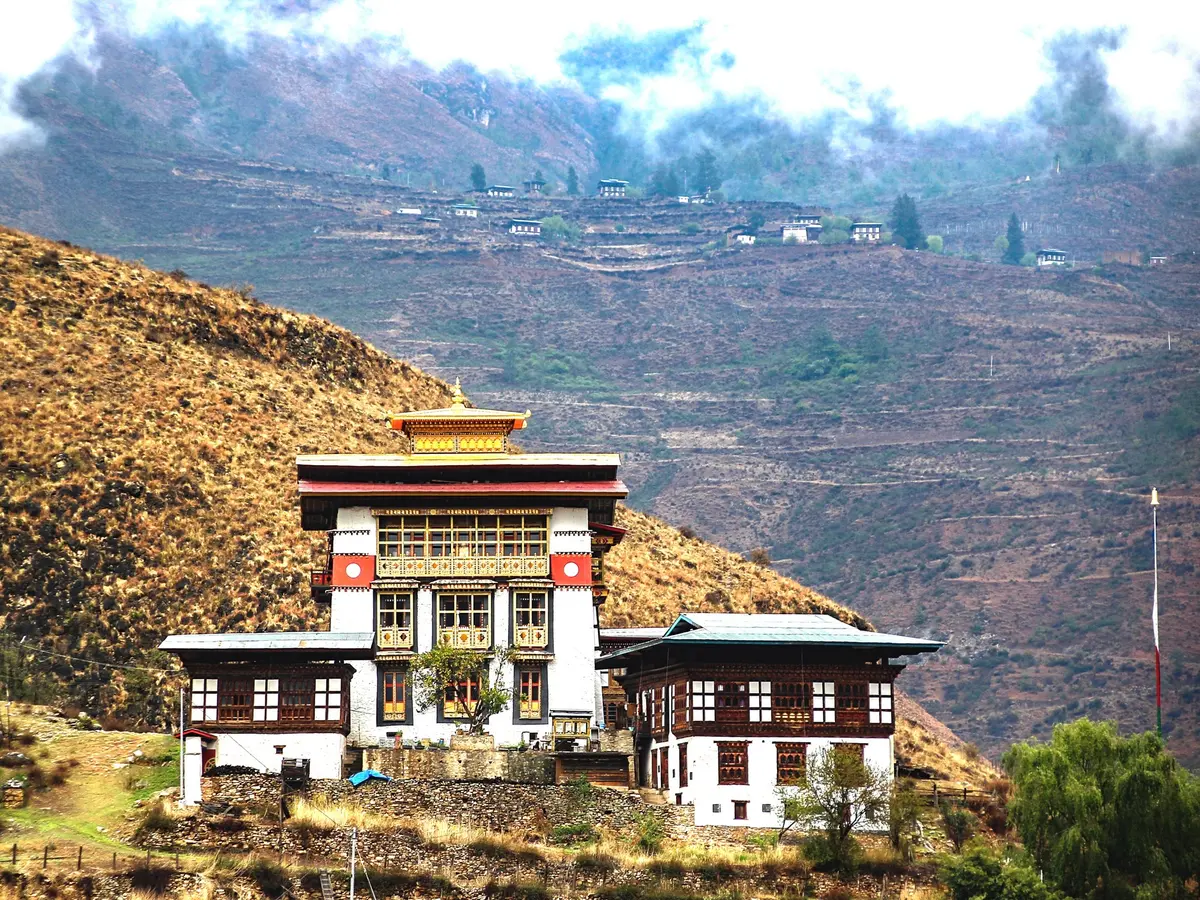
In Bhutan, art is not something meant to be hung in a silent museum; it is a breathing, functional part of daily life. This philosophy is codified in Zorig Chusum, the thirteen traditional arts and crafts of Bhutan.
These thirteen disciplines range from weaving (Thagzo) and papermaking (Dezo) to painting (Lhazo). However, when it comes to the monumental Dzongs, the heavy lifting is done by three specific disciplines:
- Shingzo (Woodcraft): The mastery of structural woodwork.
- Dozo (Stonework): The construction of massive, flared protective walls.
- Parzo (Carving): The intricate detailing of wooden pillars and cornices.
These disciplines are fiercely protected. Even today, all new buildings in Bhutan—from banks and hotels to residential homes—are legally mandated to incorporate traditional architectural elements (like the multi-colored shingtshen cornices), keeping the disciplines of Zorig Chusum alive and thriving.
The Art of Interlocking Joinery

To understand the absence of nails, you must look at the wood. Historically, iron was scarce in the remote Himalayas. But dense, old-growth timber—like blue pine and oak—was abundant.
Instead of forging iron nails that would eventually rust and decay in the damp monsoon seasons, the Zow (master carpenters) developed a highly sophisticated system of interlocking joinery.
Using a method of complex mortise and tenon joints, wooden beams are carved with mathematical precision to slot into one another like a massive, high-stakes jigsaw puzzle. Every pillar, beam, and floorboard is held in place by the sheer weight and perfect geometric tension of the pieces surrounding it. Where absolutely necessary, wooden pegs are driven into pre-drilled holes to lock a joint, expanding and contracting naturally with the wood as the temperature changes.
Because the materials are exclusively organic (wood and stone) and connected via flexible joints, the entire building acts as a single, breathable organism.
Built to Survive the Earth's Tremors
There is a brilliant, albeit accidental, engineering advantage to building without nails: seismic resilience. The Himalayas are a highly active tectonic zone. An earthquake will snap a rigid iron nail or crack modern concrete. But a massive Dzong, held together by interlocking wooden joints, has a degree of flexibility. The joints can shift, sway, and absorb the shockwaves without the structural integrity failing.
This ancient "shock absorption" is why century-old cantilever bridges—like the famous bridge over the Mo Chhu river in Punakha—can support heavy foot traffic and wild weather despite being made purely of slotted timber.
Construction Without Blueprints
If the precision of the interlocking wood isn't impressive enough, consider how the construction was organized.
When the great Zhabdrung Ngawang Namgyal (the unifier of Bhutan) ordered the construction of the major Dzongs in the 17th century, there were no architects at drafting tables. There were no blueprints, cross-sections, or AutoCAD files.
Instead, the construction of a Dzong was an act of profound spiritual vision. A high-ranking lama or a Zowe Gom (Chief Carpenter) would dictate the dimensions and design entirely from mental visualization, often guided by spiritual dreams, astrology, and meditation.
The Zowe Gom held the entire complex structure in his mind. He would direct hundreds of laborers, stone throwers, and wood carvers based entirely on oral tradition and spiritual geometry. Chants and songs set the rhythm for the workers as they pounded mud walls into stone foundations, ensuring that every layer was infused with protective mantras.
A Canvas for the Divine
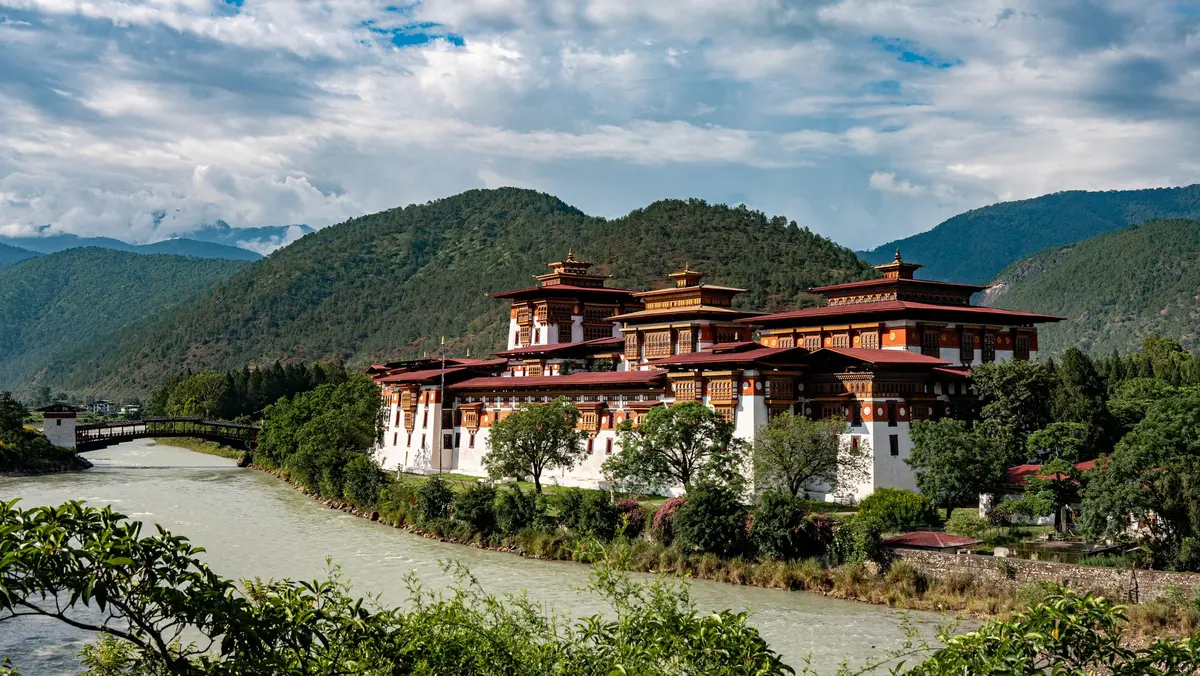
A Dzong is not just a fortress; it is the spiritual and administrative heart of the valley. As such, once the massive nail-less wooden frame is erected, it is handed over to the Lhazops (painters).
Bhutanese architecture abhors an empty space. Every pillar, doorframe, and ceiling is meticulously hand-painted with mineral-based paints. You will not find simple decorative patterns; every brushstroke has a meaning.
- The Lotus: Symbolizing purity and spiritual awakening.
- The Snow Lion: Representing fearlessness and the eastern direction.
- The Endless Knot: A reminder of the interconnectedness of all living things and the Buddha's infinite wisdom.
The colors themselves are dictated by strict rules—red wide bands (khemar) painted near the roofline signify the sacred status of the building, meaning it houses a monastery or important relics.
Witnessing the Masterpiece Today
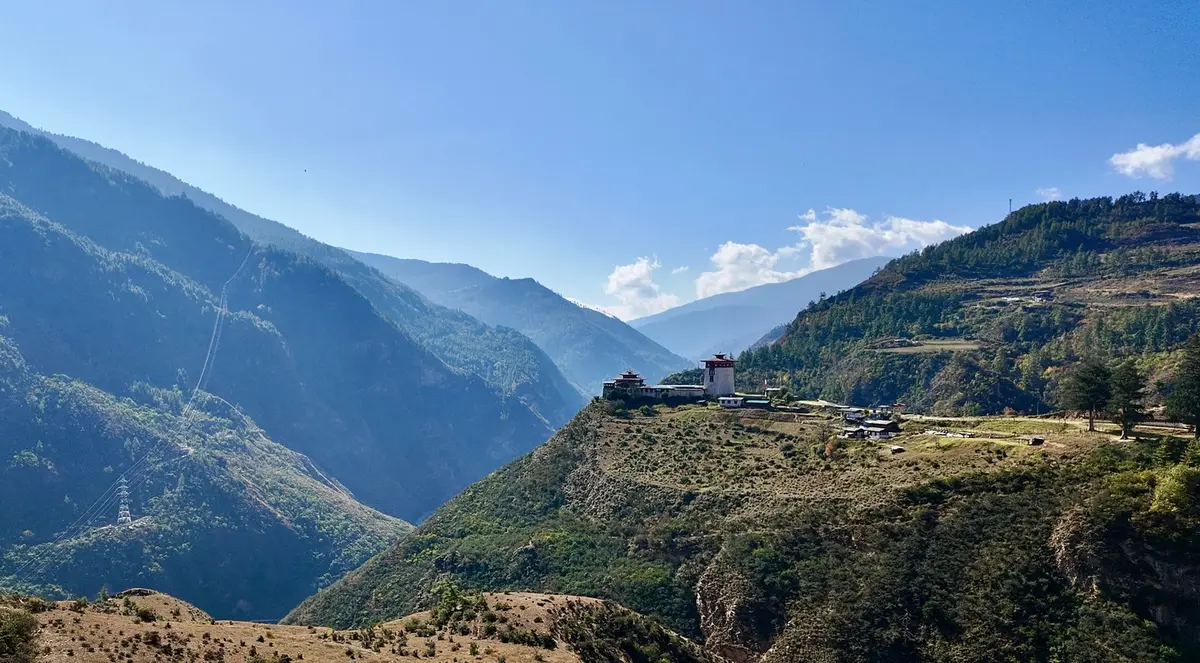
In a modern world obsessed with speed, cheap materials, and mass production, the traditional architecture of Bhutan stands as a profound testament to the power of human patience, spiritual dedication, and harmony with nature.
Walking through the colossal wooden courtyards of the Punakha Dzong—surrounded by the roaring confluence of the Pho Chhu and Mo Chhu rivers—you can feel the silent, ancient tension of the wood holding the fortress together as it has for 400 years.
To witness this majestic architecture is to step back into a timeline where buildings were crafted not just to shelter humans, but to house the divine.
Ready to walk across nail-less cantilever bridges and touch the ancient stones of Bhutan’s greatest fortresses? Explore our curated Cultural Tours and let us guide you through the architectural wonders of the Himalayas.